
Most everything I know about multiple sclerosis came after my diagnosis. I had a general knowledge base of what it was and thought I knew what I was up against. Boy, was I ever wrong! I was blindsided by how complicated the condition is and how complex the symptoms can be. I thought people with MS had memory issues, slowly lost their ability to walk, eventually would be in a wheelchair, and that was that. I thought that was the future now laid out before me. It still may be, but chances are MS has other plans. Lots of other plans as it turns out.
The Central Nervous System
I am going to assume it has been a while since most of us have had a human anatomy class, so a simple review won’t hurt. I will stick to just the parts that matter.
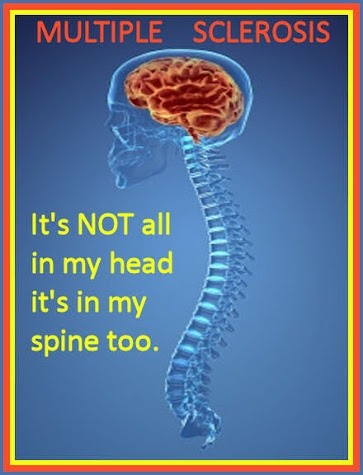
The central nervous system (CNS) consists of the brain and spinal cord and is the processing center for the body. The CNS, specifically the brain, controls all of our senses (sight, sound, smell, taste, and touch), along with our awareness, thoughts, movement, speech, and basically all other bodily functions.
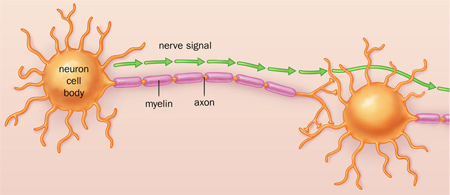
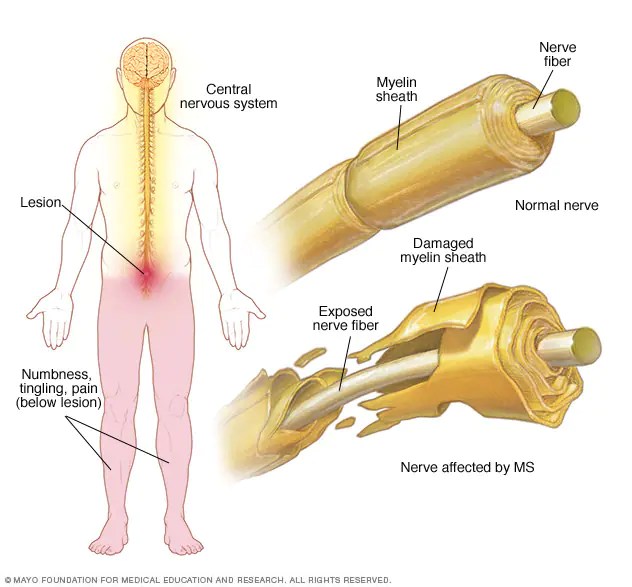
The basic unit of the CNS is the neuron. Neurons are arranged in a network and carry electrical signals to and from the brain. Axons are long cords that extend from neuron to neuron to arrange that network. Axons are coated in an insulation called myelin. Myelin increases the speed at which neurons are able to convey messages across the network.
Autoimmune Disease
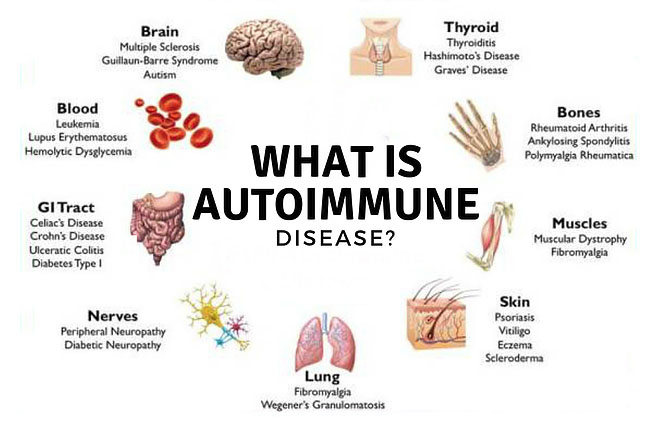
Autoimmune disease happens when the immune system is unable to recognize the body’s own healthy cells and begins to attack healthy cells and tissue.
According to the National Institutes of Health, more than 25 million people are affected by autoimmune disease. There are currently more than eighty autoimmune disorders. Some of the more recognized include type 1 diabetes, rheumatoid arthritis, psoriasis, lupus, celiac disease, Crohn’s, fibromyalgia, and, of course, multiple sclerosis. The area of the body and types of tissue the immune system attacks determines the type of autoimmune disease.
Multiple Sclerosis
In the case of MS, the immune system becomes triggered to attack the CNS. The exact reason why this happens is unknown.
Remember in our anatomy lesson above that myelin is the fatty sheath insulating the axons and is responsible for the speed neurons are able to pass information back and forth from our brain to the rest of our body. For people with MS, the immune system mistakes this myelin as a foreign body and attacks it. As the myelin is destroyed, it leaves behind scar tissue, more commonly known as a lesion in MS.
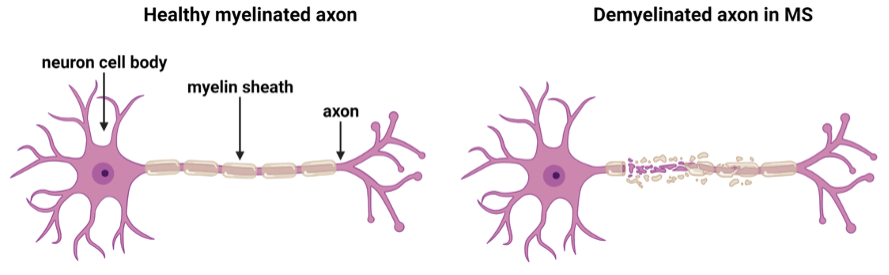
Where there are lesions, signals are no longer able to pass as quickly across the neurons. This causes a major delay between the brain and area of damage. For example, I have a large lesion on one side of my brain stem. This lesion slows signals between my brain and right side of my body. So, when I want to walk, my brain sends a signal to my legs to move. My left leg gets the signal instantaneously, whereas the message to my right leg gets delayed because the pathway is partially blocked by a lesion. My left leg will lift off the ground. My right leg will lift, but only a fraction of what I need it to. It still gets the signal, but only partially.
The other major problem I have is right arm weakness. I have difficulty gripping a pen, my toothbrush, a razor, etc. Anything small and thin is difficult to maneuver since MS has obliterated my fine motor skills.
Lesions not only affect the spinal cord and brain stem, but the brain itself. Symptoms will vary depending on where the damage is done. For example, the frontal lobe of the brain controls aspects of a person’s personality. MS damage to the frontal lobe can cause changes to a person’s mood or behavior. Whereas damage to the temporal lobe may cause memory impairment and fatigue.
MS Relapse and Remission
A person with Relapsing Remitting Multiple Sclerosis (RRMS) can go into remission. During remission, the disease is no longer active and doing damage to the CNS. Depending on how much damage was done, a person may completely recover from the symptoms they were having during the relapse, or the damage may be permanent. The lesion on my brain stem and it’s symptoms are there to stay. In more advanced stages of MS, the disease no longer goes into remission and remains active.
RRMS is unpredictable. Remission could last for days, weeks, months, or even years. Even if a person has gone an extended period of time without a relapse, they still have the disease. MS is treatable but has no cure. When the disease relapses, it could last for days or weeks.
When a relapse does happen, this means the disease is actively attacking the CNS. Old symptoms could worsen, or new symptoms could appear. These attacks will vary from person to person and symptoms will vary based on the area of the CNS the disease is affecting. A relapse could mean a bout of optic neuritis for some people or overwhelming fatigue for others. It could also simply mean waiting a few days to feel better or a trip to the emergency room.
Relapses are scary business. You know what is happening. You know your immune system is eating away at your central nervous system. Your body is literally fighting itself and that is one of the most exhausting feelings you will ever experience. You are tired and scared. You are not sure if the effects will be long lasting or if you will recover. You know chances are that when you do recover, there will be a lasting symptom you did not have before. You simply wait it out and see what happens (with or without the help of steroids to ease and shorten the attack).
cover photo credit: suddenlyms.com
 (M)y (S)tory