
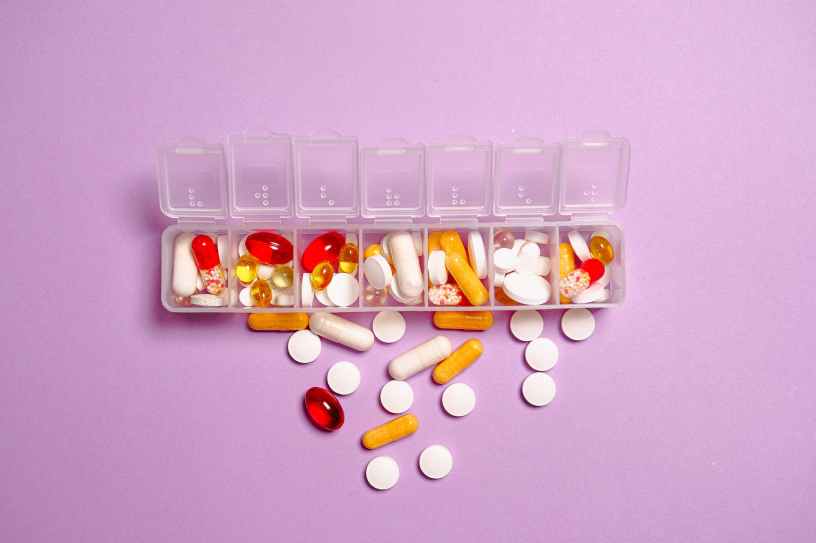
I can not remember why, or if there even was a reason, but I stopped taking vitamins when I was diagnosed with multiple sclerosis. Looking back I think it was some sort of misguided rebellion. My logic was somewhere along the lines of if I got sick while taking the vitamins then they were not doing their job anyway so there was no point in continuing to take them.
I recently added vitamins back onto the daily to-do list. By recently, I mean a few days ago. I realize that is not enough time for any of them to build up in my system and for me to notice any effect. However, I am feeling better already. I worry because I succumb to the placebo effect almost every time I try something new. I completely understand the possibility that anything I am currently experiencing will fade in time as reality begins to set back in. But, for now, I am going to enjoy my newfound feeling of being somewhat refreshed.
When I was diagnosed with MS, the only thing I was taking on a regular basis was a daily multivitamin and an Omega 3. The multivitamin was for general health maintenance. It did not contain any extreme amounts of anything. I was taking the Omega 3 because at the time I was a vegetarian that did not eat fish.
I recently decided the multivitamin I was taking at the time of my diagnosis was just an innocent bystander and there was not much it could have done to prevent the impending catastrophe happening in my nervous system. I decided to give vitamins another shot. Following is the current repertoire.
Vitamin B12
Vitamin B12 has numerous health benefits. B12 helps to keep the body’s red blood cells healthy and to form DNA. When it comes to MS, Vitamin B12 can play an essential role in nerve health by regenerating nerve fibers and repairing nerve damage. Part of this role includes making myelin, the protective sheath around nerve fibers. Myelin is the part of the nervous system that suffers damage when the immune system goes haywire in people with MS.
Vitamin B12 is found in meat, fish, cheese, eggs, and milk.
Vitamin B12 (as Cyanocobalamin) 2500 mcg 104,1067%
Vitamin D & K2
Vitamin D, while present in a few foods, is mainly obtained when ultraviolet light from the sun interacts with the skin to trigger Vitamin D synthesis. Vitamin D promotes calcium absorption, reduces inflammation, and helps regulate processes such as cell growth, immune function, and glucose metabolism. The role Vitamin D plays in MS is debatable and worthy of an entire post itself. What we do know is that higher levels of Vitamin D in the body are associated with a lower risk of developing MS.
Vitamin D is found in tuna fish, swordfish, salmon, sardines, beef liver, fortified cereals, and fortified milk or orange juice.
Vitamin D (as Cholecalciferol) 125 mcg 625%
Vitamin K2 (as MK-7) 100%
Omega 3
Omega 3 is an essential part of cell membranes. These fatty acids provide the starting point for making hormones that regulate blood clotting and inflammation. Omega 3 also plays an important role in heart health and function. While it is still up for debate, a lot of studies have shown that Omega 3 may impede the progress or severity of MS.
Fish is the best source for obtaining Omega 3, in particular herring, wild salmon, and bluefin tuna.
Omega 3 (from Algal {schizochytrium sp.} Oil) 770 mg
DHA (Docosahexaenoic Acid) 420 mg
EPA (Eicosapentaenoic Acid) 210 mg
Biotin
Biotin supports nerve cell metabolism and is thought to promote myelin repair in very high doses. You can purchase doses of Biotin a lot higher than the 5,000 mcg I currently take.
Some common food sources of Biotin include egg yolk, organ meats, nuts, soybeans, whole grains, cauliflower, and bananas.
Biotin (as d-Biotin) 5,000 mcg 1667%
Alpha Lipoic Acid
Alpha lipoic acid is an antioxidant made naturally in the body and found in foods. It is used by the body to break down carbohydrates and make energy. In MS, it is believed that alpha lipoic acid is able to reduce the number of inflammatory immune cells that migrate to the nervous system and cause damage.
Alpha lipoic acid can be found in beets, spinach, broccoli, and potatoes.
*I have not started alpha lipoic acid, yet. It was recommended and I plan to add it soon.
Alpha Lipoic Acid 600 mg
Multivitamin
Vitamin A (as Beta-Carotene from Blakeslea Trispora) 900 mcg 100%
Vitamin C (from L-Ascorbate and Acerola Cherry Extract) 90 mg 100%
Vitamin D3 (Plant-Based Cholecalciferol from Wild-harvested Lichen) 20 mcg 100%
Vitamin E (from d-Alpha Tocopheryl from Sunflower) 15 mg 100%
Vitamin K2 (as Menaquinone MK-7) 120 mcg 100%
Vitamin B1 (from Thiamine HCl) 1.2 mg 100%
Vitamin B2 (Riboflavin) 1.3 mg 100%
Vitamin B3 (as Niacinamide) 16 mg 100%
Vitamin B6 (from Pyridoxal-5-Phosphate) 1.7 mg 100%
Folate [as Active L-5-Methylfolate) 400 mcg DFE 100%
Vitamin B12 (as Methylcobalamin) 2.4 mcg 100%
Biotin (as D-Biotin) 30 mcg 100%
Vitamin B5 (as d-Calcium Pantothenate) 5 mg 100%
Calcium (from plant-based Aquamin® from Marine Algae and Dicalcium Phosphate) 50 mg 4%
Iron (as Ferrous Fumarate) 9 mg 50%
Phosphorus (from Dicalcium Phosphate) 8 mg 1%
Iodine (from Wild-Harvested Kelp) 100 mcg 67%
Magnesium (as Aquamin® Magnesium from Marine Algae) 50 mg 12%
Zinc (Amino Acid Chelate) 10 mg 91%
Selenium (as Selenium Glycinate)(Albion®) 50 mcg 91%
Copper (as Copper Aminomin) 0.5 mg 56%
Manganese (Manganese Sulfate) 1.5 mg 65%
Chromium (from Chromium Polynicotinate) 30 mcg 86%
Molybdenum (as Krebs Complex) 40 mcg 89%
Organic Fruit & Vegetable Blend [Organic Carrot (Root), Organic Blueberry (Berry), Organic Kale (Whole Plant), Organic Pomegranate (Whole Fruit Juice), Organic Raspberry (Berry), Organic Spinach (Leaf/Stalk)] 60 mg.
I would love to hear what everyone else is taking. Let me know in the comments below! As always, you should discuss vitamins and supplements with your healthcare provider.
 (M)y (S)tory